Moderating effect of self compassion on compassion fatigue and satisfaction among counselors
While compassion has historically been explored across diverse fields like philosophy, religion, and ethics, its scientific investigation, particularly within psychology and mental health, has gained significant momentum over the past two decades1,2. This heightened interest, largely influenced by the rise of positive psychology3, underscores compassion’s therapeutic function, healing capacity, and interpersonal benefits across various professional contexts, including healthcare, education, and social work4,5. Despite this growing recognition of compassion’s importance in supporting individuals, a notable gap exists concerning the specific compassion experiences of mental health professionals, especially counselors. Although self-compassion is acknowledged as a crucial concept in mental health and therapy research6,7,8, its comprehensive investigation among counselors remains limited9. Given that counselors inherently rely on compassion in their helping roles10,11, a deeper understanding of their compassion experiences, including self-compassion, is essential.
As professionals providing guidance and psychological counseling services, especially in school settings, counselors play a critical role in supporting students’ academic, social, and emotional development12,13. Their work involves addressing a wide range of challenging student problems, including academic difficulties, mental health issues like depression and anxiety, and severe social concerns such as bullying or addiction14,15. Constantly engaging with distress and crisis situations16,17 can expose counselors to significant emotional strain, potentially leading to compassion fatigue (CF), characterized by professional burnout and secondary traumatic stress18,19,20. Conversely, successfully guiding students through their difficulties and observing positive outcomes can lead to profound professional and emotional fulfillment, known as compassion satisfaction (CS)21,22.
CF and CS
CF and CS are concepts related to occupational quality of life. Occupational quality of life is an important quality that a person feels when helping people in their professional life. This quality shows up in negative (CF) and positive (CS) ways. The negative aspect is divided into two parts: burnout and secondary traumatic stress. The positive aspect is known as CS21.
The concept of CF, introduced by Figley in the 1980s, was originally used to refer to secondary trauma18. CF is a state of burnout experienced due to the support and help provided to individuals who are suffering, victimized, and in need23. Counselors who provide psychological support in schools may also experience CF, as they serve many students who suffer from emotional and social problems. Counselors who encounter cases such as trauma, suicide, abuse, and violence sometimes have to carry out psychosocial activities lasting weeks or months. Through these long-term efforts, counselors are likely to experience stress, feelings of inadequacy, and burnout in their professional lives24. Counselors may develop CF while helping students, parents, or other school staff, which can cause them to become indifferent and insensitive to students’ problems and make it difficult to listen to and endure students’ pain18. Counselors experiencing CF may face physical, psychological, and emotional burnout25.
Counselors do not always experience fatigue, burnout, stress, or CF as a consequence of their service. Counseling has both challenging and rewarding aspects. Therefore, some counselors may feel fulfilled when providing psychological support to students in difficult situations. In other words, counselors can gain inner peace through their work. A counselor who observes that a student’s distress is reduced, their problems are solved, and their pain is alleviated may find greater satisfaction in their professional life. For example, a counselor who plays an active role in protecting the mental health of a self-harming student may feel professional satisfaction by recognizing the importance of their work. Counselors who feel more comfortable mentally and emotionally and appreciate the service and support they provide to students, families, and teachers are more likely to experience CS.
The opposite pole of CF is CS. Therefore, CS can be effective in reducing and preventing CF26. Accordingly, it is important for counselors to experience CS in order to experience less CF. Many factors can influence the reduction of CF or the development of CS. These factors include not only lifestyle practices such as meditation, spirituality-based rituals, nature walks, and balanced nutrition but also individual characteristics such as personality traits, coping strategies, and social support networks, which have been shown to impact resilience and wellbeing23,27. Additionally, self-compassion has been found to be effective in both reducing CF9 and enhancing CS28, highlighting its role as a protective factor in counselors’ occupational wellbeing.
Self-compassion
Self-compassion is defined as the capacity to approach one’s own difficulties, failures, and imperfections with kindness and understanding, recognizing these experiences as an inherent part of the shared human condition29,30. This perspective encourages individuals to treat themselves with the same warmth and empathy they would extend to a close friend in distress, rather than engaging in harsh self-criticism or judgment. Individuals high in self-compassion are more likely to acknowledge their inadequacies without damaging their self-identity, embracing the understanding that imperfection and making mistakes are universal experiences31.
Three components of self-compassion are mentioned. First, when an individual is faced with pain and difficulties, instead of criticizing and judging oneself harshly, he/she shows kindness and understanding towards oneself. Second, instead of isolating oneself by burying oneself in problems and sorrows, the individual perceives these as a common experience of humanity. The third is that the individual is mindful of what he/she experiences and develops a balanced awareness of negative experiences instead of identifying with difficult experiences by making painful feelings and thoughts his/her own identity and self29,30. Self-compassion is an important factor for a person to lead a peaceful life, to have good mental health, and to have functional relationships with people. Self-compassion is an effective variable in one’s ability to struggle with difficulties. Individuals with high levels of self-compassion may also have high levels of well-being32.
Recent research underscores the protective role of self-compassion in helping professions. For instance, Mantelou and Karakasidou33 found that self-compassion among mental health professionals enhanced subjective happiness and improved professional quality of life by mitigating the adverse effects of CF. Similarly, Yu et al.34 demonstrated that self-compassion effectively reduced CF and increased CS in emergency nurses. These findings suggest that self-compassion is likely a crucial resource for counselors, enabling them to navigate the challenges of their profession with greater resilience. When counselors cultivate self-compassion, they may experience reduced stress, fatigue, and burnout associated with CF, while simultaneously deriving greater satisfaction from their compassionate engagement. Consequently, this study specifically posits that self-compassion functions as a critical moderator in the relationship between CF and CS among counselors.
The present study
The counseling process inherently involves compassion, which may expose counselors to experiences such as fear of compassion, CF, and CS depending on the nature of their work35,36. Counselors who consistently demonstrate compassion toward others may also neglect their own needs37. Although compassion extends beyond others to include oneself, many counselors lack awareness of how to practice self-compassion, have limited understanding of its application, or struggle to implement it despite knowing its importance38. This situation may have challenging consequences for counselors, leading to burnout and secondary traumatic stress17,39. Given these concerns, it is crucial to understand and determine counselors’ compassion experiences related to their professional roles.
To address this need, the present study aimed to examine the compassion experiences of psychological counselors by investigating their levels of CF, CS, and self-compassion and the relationships among these variables. Importantly, to our knowledge, no previous studies have examined self-compassion as a moderator of the relationship between CF and CS among Turkish counselors. Addressing this gap, we aimed to explore the moderating role of self-compassion in this relationship to provide insights into protective factors that may support counselor wellbeing in Türkiye.
Self-compassion has been recognized as a component of emotional self-regulation and resilience, which can help individuals manage stress and maintain wellbeing in demanding professional roles29,30. In the context of counseling, self-compassion may reduce the negative impact of CF on CS by allowing counselors to respond to work-related stress with greater emotional balance. Therefore, we expected self-compassion to moderate the relationship between CF and CS among Turkish counselors.
Based on this theoretical framework, the study tested the following hypotheses:
Hypothesis 1 (H
1)
CF is negatively correlated with CS
Hypothesis 2 (H
2)
Self-compassion is positively correlated with CS.
Hypothesis 3 (H
3)
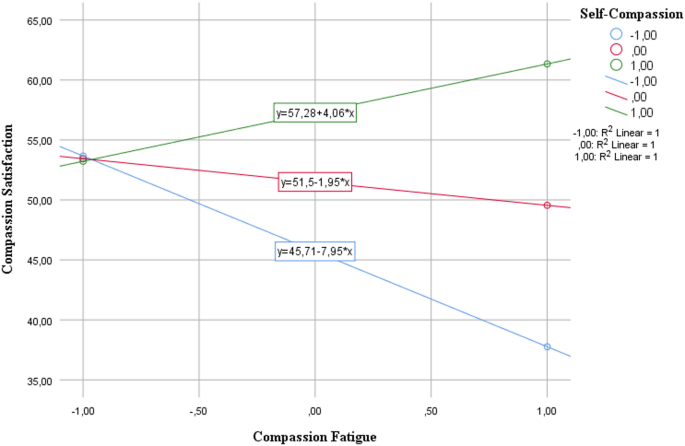
Self-compassion moderates the relationship between CF and CS.
link