


Fergusson, D. M., Boden, J. M. & Horwood, L. J. Recurrence of major depression in adolescence and early adulthood, and later mental health, educational and economic outcomes. Br. J. Psychiatry 191, 335–342 (2007).
Google Scholar
Committee on Psychosocial Aspects of Child Family Health et al. Early childhood adversity, toxic stress, and the role of the pediatrician: translating developmental science into lifelong health. Pediatrics 129, e224–e231 (2012).
Google Scholar
Kieling, C. et al. Worldwide prevalence and disability from mental disorders across childhood and adolescence: evidence from the global burden of disease study. JAMA Psychiatry 81, 347–356 (2024).
Google Scholar
Thapar, A., Eyre, O., Patel, V. & Brent, D. Depression in young people. Lancet 400, 617–631 (2022).
Google Scholar
Gili, M. et al. Mental disorders as risk factors for suicidal behavior in young people: a meta-analysis and systematic review of longitudinal studies. J. Affect. Disord. 245, 152–162 (2019).
Google Scholar
Viner, R. M. et al. Adolescence and the social determinants of health. Lancet 379, 1641–1652 (2012).
Google Scholar
NOAA National Centers for Environmental Information. Annual 2022 Global Climate Report. (2023).
Obradovich, N., Migliorini, R., Paulus, M. P. & Rahwan, I. Empirical evidence of mental health risks posed by climate change. Proc. Natl. Acad. Sci. USA 115, 10953–10958 (2018).
Google Scholar
Mitchell, A., Maheen, H. & Bowen, K. Mental health impacts from repeated climate disasters: an Australian longitudinal analysis. Lancet Reg. Health West. Pac. 47 (2024).
Watts, N. et al. The Lancet Countdown on health and climate change: from 25 years of inaction to a global transformation for public health. Lancet 391, 581–630 (2018).
Google Scholar
UNICEF. A threat to progress: confronting the effects of climate change on child health and well-being. (2024).
UNICEF. Almost half a billion children live in areas experiencing at least twice as many extremely hot days as their grandparents, (2024).
O’Neill, M. S. & Ebi, K. L. Temperature Extremes and Health: Impacts of Climate Variability and Change in the United States. J. Occupat. Environ. Med. 51, 13–25 (2009).
Google Scholar
Martin, G., Reilly, K., Everitt, H. & Gilliland, J. A. Review: the impact of climate change awareness on children’s mental well-being and negative emotions—a scoping review. Child Adolesc. Ment. Health 27, 59–72 (2022).
Google Scholar
Albrecht, G. et al. Solastalgia: the distress caused by environmental change. Australas. Psychiatry 15, S95–S98 (2007).
Google Scholar
Palinkas, L. A. & Wong, M. Global climate change and mental health. Curr. Opin. Psychol. 32, 12–16 (2020).
Google Scholar
Kovats, R. S. & Hajat, S. Heat stress and public health: a critical review. Annu. Rev. Public Health 29, 41–55 (2008).
Google Scholar
Pfautsch, S., Wujeska-Klause, A. & Walters, J. Outdoor playgrounds and climate change: Importance of surface materials and shade to extend play time and prevent burn injuries. Build. Environ. 223, 109500 (2022).
Google Scholar
Mullins, J. T. & White, C. Temperature and mental health: evidence from the spectrum of mental health outcomes. J. Health Econ. 68, 102240 (2019).
Google Scholar
Yablonskiy, D. A., Ackerman, J. J. H. & Raichle, M. E. Coupling between changes in human brain temperature and oxidative metabolism during prolonged visual stimulation. Proc. Natl. Acad. Sci. USA 97, 7603–7608 (2000).
Google Scholar
McMorris, T. et al. Heat stress, plasma concentrations of adrenaline, noradrenaline, 5-hydroxytryptamine and cortisol, mood state and cognitive performance. Int. J. Psychophysiol. 61, 204–215 (2006).
Google Scholar
Thompson, R. et al. Ambient temperature and mental health: a systematic review and meta-analysis. Lancet Planet. Health 7, e580–e589 (2023).
Google Scholar
Liu, J. et al. Is there an association between hot weather and poor mental health outcomes? A systematic review and meta-analysis. Environ. Int. 153, 106533 (2021).
Google Scholar
Morgan, R. L. et al. GRADE: Assessing the quality of evidence in environmental and occupational health. Environ. Int. 92-93, 611–616 (2016).
Google Scholar
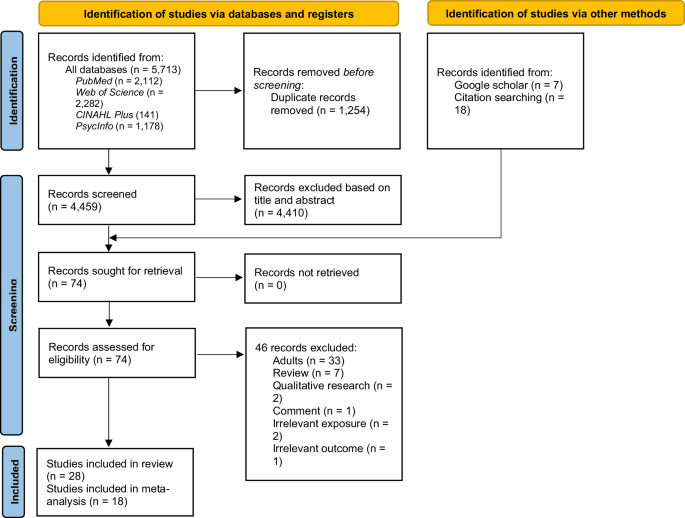
Page, M. J. et al. The PRISMA 2020 statement: an updated guideline for reporting systematic reviews. BMJ 372, n71 (2021).
Google Scholar
Sawyer, S. M., Azzopardi, P. S., Wickremarathne, D. & Patton, G. C. The age of adolescence. Lancet Child Adolesc. Health 2, 223–228 (2018).
Google Scholar
Hwong, A. R. et al. Climate change and mental health research methods, gaps, and priorities: a scoping review. Lancet Planet. Health 6, e281–e291 (2022).
Google Scholar
National Toxicology Program US Department of Health and Human Services National Institutes of Health. OHAT Risk of Bias Rating Tool for Human and Animal Studies. (2015).
Guyatt, G. H. et al. What is “quality of evidence” and why is it important to clinicians?. BMJ 336, 995 (2008).
Google Scholar
Rooney, A. A., Boyles, A. L., Wolfe, M. S., Bucher, J. R. & Thayer, K. A. Systematic review and evidence integration for literature-based environmental health science assessments. Environ. Health Perspect. 122, 711–718 (2014).
Google Scholar
IntHout, J., Ioannidis, J. P. A. & Borm, G. F. The Hartung-Knapp-Sidik-Jonkman method for random effects meta-analysis is straightforward and considerably outperforms the standard DerSimonian-Laird method. BMC Med. Res. Methodol. 14, 25 (2014).
Google Scholar
World Health Organization. Adolescent health: Overview, (2025).
Borenstein, M. Avoiding common mistakes in meta-analysis: Understanding the distinct roles of Q, I-squared, tau-squared, and the prediction interval in reporting heterogeneity. Res. Synth. Methods 15, 354–368 (2024).
Google Scholar
Higgins, J. P. T., Thompson, S. G., Deeks, J. J. & Altman, D. G. Measuring inconsistency in meta-analyses. BMJ 327, 557 (2003).
Google Scholar
Egger, M., Smith, G. D., Schneider, M. & Minder, C. Bias in meta-analysis detected by a simple, graphical test. BMJ 315, 629 (1997).
Google Scholar
Sedgwick, P. Meta-analyses: how to read a funnel plot. Br. Med. J. 346, f1342 (2013).
Google Scholar
Stata Statistical Software: Release 17 (Stata Corp. 2021).
Basu, R., Gavin, L., Pearson, D., Ebisu, K. & Malig, B. Examining the association between apparent temperature and mental health-related emergency room visits in California. Am. J. Epidemiol. 187, 726–735 (2018).
Google Scholar
Villeneuve, P. J. et al. Daily changes in ambient air pollution concentrations and temperature and suicide mortality in Canada: Findings from a national time-stratified case-crossover study. Environ. Res. 223, 115477 (2023).
Google Scholar
Bernstein, A. aron et al. Warm season and emergency department visits to U.S. Children’s Hospitals. Environ. Health Perspect. 130, 017001 (2022).
Google Scholar
Chan, E. Y. Y. et al. Association between Ambient Temperatures and Mental Disorder Hospitalizations in a Subtropical City: A Time-Series Study of Hong Kong Special Administrative Region. Int. J. Environ. Res. Public Health 15, 754 (2018).
Google Scholar
da Silva, I., de Almeida, D. S., Hashimoto, E. M. & Martins, L. D. Risk assessment of temperature and air pollutants on hospitalizations for mental and behavioral disorders in Curitiba, Brazil. Environ. Health 19, 79 (2020).
Google Scholar
Isaksen, T. B. et al. Increased mortality associated with extreme-heat exposure in King County, Washington, 1980–2010. Int. J. Biometeorol. 60, 85–98 (2016).
Google Scholar
Niu, Y. et al. Short-term effect of apparent temperature on daily emergency visits for mental and behavioral disorders in Beijing, China: a time-series study. Sci. Total Environ. 733, 139040 (2020).
Google Scholar
Parks, R. M. et al. Anomalously warm temperatures are associated with increased injury deaths. Nat. Med. 26, 65–70 (2020).
Google Scholar
Zhou, Y. et al. The role of extreme high humidex in depression in chongqing, China: a time series-analysis. Environ. Res. 222, 115400 (2023).
Google Scholar
Wang, S. et al. Effect of increasing temperature on daily hospital admissions for schizophrenia in Hefei, China: a time-series analysis. Public Health 159, 70–77 (2018).
Google Scholar
Zhou, Q. et al. Immediate and delayed effects of environmental temperature on schizophrenia admissions in Liuzhou, China, 2013–2020: a time series analysis. Int. J. Biometeorol. 68, 843–854 (2024).
Google Scholar
Trang, P. M., Rocklöv, J., Giang, K. B., Kullgren, G. & Nilsson, M. Heatwaves and hospital admissions for mental disorders in Northern Vietnam. PLoS One 11, e0155609 (2016).
Google Scholar
Nitschke, M., Tucker, G. R. & Bi, P. Morbidity and mortality during heatwaves in metropolitan Adelaide. Med. J. Aust. 187, 662–665 (2007).
Google Scholar
Kim, Y. et al. Suicide and ambient temperature in East Asian countries: a time-stratified case-crossover analysis. Environ. Health Perspect. 124, 75–80 (2016).
Google Scholar
Niu, L. et al. Temperature and mental health–related emergency department and hospital encounters among children, adolescents and young adults. Epidemiol. Psychiatr. Sci. 32, e22 (2023).
Google Scholar
Rahman, M. M. et al. Ambient temperature and air pollution associations with suicide and homicide mortality in California: A statewide case-crossover study. Sci. Total Environ. 874, 162462 (2023).
Google Scholar
Zhang, S. et al. The effect of temperature on cause-specific mental disorders in three subtropical cities: a case-crossover study in China. Environ. Int. 143, 105938 (2020).
Google Scholar
Cohen, G. et al. Daily temperature variability and mental health-related hospital visits in New York State. Environ. Res. 257, 119238 (2024).
Google Scholar
He, W.-Q. et al. Extreme heat stress and unplanned hospital admissions. Pediatrics 155, e2024068183 (2024).
Google Scholar
Ndovu, A. et al. Spatial variation in the association between extreme heat events and warm season pediatric acute care utilization: a small-area assessment of multiple health conditions and environmental justice implications in California (2005–2019). Environ. Health Perspect. 133, 017010 (2025).
Google Scholar
Zhong, Z. et al. The impact of different types of extreme temperature events on mental disorders: a case-crossover study in Anhui Province, China. Environ. Res. 277, 121526 (2025).
Google Scholar
Stowell, J. D. et al. Warm-season temperatures and emergency department visits among children with health insurance. Environ. Res. Health 1, 015002 (2023).
Google Scholar
Komulainen, K. et al. Climatic exposures in childhood and the risk of schizophrenia from childhood to early adulthood. Schizophr. Res. 248, 233–239 (2022).
Google Scholar
Xu, Y., Wheeler, S. A. & Zuo, A. Will boys’ mental health fare worse under a hotter climate in Australia?. Popul. Environ. 40, 158–181 (2018).
Google Scholar
Hu, J. et al. Associations of exposure to heatwaves with depression and anxiety among adolescents: a cross-sectional study of the Chinese adolescent health survey. J. Affect. Disord. 387, 119499 (2025).
Google Scholar
Runkle, J. D. et al. Assessing the impact of heatwaves on emergency visits for major depression and suicidal ideation in youth with attention-deficit/hyperactivity disorder. PLOS Ment. Health 2, e0000444 (2025).
Google Scholar
Florido Ngu, F., Kelman, I., Chambers, J. & Ayeb-Karlsson, S. Correlating heatwaves and relative humidity with suicide (fatal intentional self-harm). Sci. Rep. 11, 22175 (2021).
Google Scholar
Rother, H.-A. et al. Impact of extreme weather events on Sub-Saharan African child and adolescent mental health: the implications of a systematic review of sparse research findings. J. Clim. Change Health 5, 100087 (2022).
Google Scholar
Uibel, D., Sharma, R., Piontkowski, D., Sheffield, P. E. & Clougherty, J. E. Association of ambient extreme heat with pediatric morbidity: a scoping review. Int. J. Biometeorol. 66, 1683–1698 (2022).
Google Scholar
Fung, K. Y., Krewski, D., Chen, Y., Burnett, R. & Cakmak, S. Comparison of time series and case-crossover analyses of air pollution and hospital admission data. Int. J. Epidemiol. 32, 1064–1070 (2003).
Google Scholar
Bhaskaran, K., Gasparrini, A., Hajat, S., Smeeth, L. & Armstrong, B. Time series regression studies in environmental epidemiology. Int. J. Epidemiol. 42, 1187–1195 (2013).
Google Scholar
Maclure, M. & Mittleman, M. A. Should we use a case-crossover design?. Annu. Rev. Public Health 21, 193–221 (2000).
Google Scholar
Haines, A. et al. Public health benefits of strategies to reduce greenhouse-gas emissions: overview and implications for policy makers. Lancet 374, 2104–2114 (2009).
Google Scholar
Reed, A., Henning, B., Cortes Espinosa, M., McKinley, H. & Busch Isaksen, T. Building community resilience to extreme heat: Lessons learned from Spokane, WA community conversations. Environ. Res. Health 2, 045007 (2024).
Google Scholar
Johar, H. et al. Community-based heat adaptation interventions for improving heat literacy, behaviours, and health outcomes: a systematic review. Lancet Planet. Health 9, 101207 (2025).
Google Scholar
Ahdoot, S. et al. Climate change and children’s health: building a healthy future for every child. Pediatrics 153, e2023065504 (2024).
Google Scholar
Hyndman, B. & Zundans-Fraser, L. Determining public perceptions of a proposed national heat protection policy for Australian schools. Health Promotion J. Aust. 32, 75–83 (2021).
Google Scholar
Bitsko, R. H. Mental health surveillance among children—United States, 2013–2019. MMWR Suppl. 71, 1–42 (2022).
Marrast, L., Himmelstein, D. U. & Woolhandler, S. Racial and ethnic disparities in mental health care for children and young adults: a national study. Int. J. Health Serv. 46, 810–824 (2016).
Google Scholar
Reiss, F. Socioeconomic inequalities and mental health problems in children and adolescents: A systematic review. Soc. Sci. Med. 90, 24–31 (2013).
Google Scholar
Bathiany, S., Dakos, V., Scheffer, M. & Lenton, T. M. Climate models predict increasing temperature variability in poor countries. Sci. Adv. 4, eaar5809 (2018).
Google Scholar
Benz, S. A. & Burney, J. A. Widespread race and class disparities in surface urban heat extremes across the United States. Earth’s. Future 9, e2021EF002016 (2021).
Google Scholar
Gronlund, C. J. Racial and socioeconomic disparities in heat-related health effects and their mechanisms: a review. Curr. Epidemiol. Rep. 1, 165–173 (2014).
Google Scholar
Rakesh, A. et al. Extreme heat: a global call to action. Bull. World Health Organ. 103, 466 (2025).
Google Scholar
link